




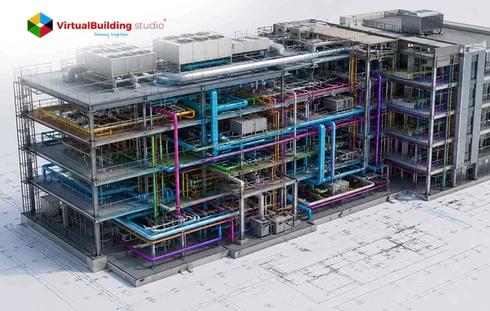
MEP systems compete for the same spatial envelope on every construction project floor. Ductwork occupies the same ceiling zones as structural frames and conduit pathways. A single undetected conflict triggers a cascade of costly field stoppages across every trade. Clash detection empowers project teams to find every conflict inside a digital model before construction starts.
Late discovery of conflict carries severe financial consequences for every project stakeholder. Field crews face extended work stoppages as redesign teams scramble to correct spatial errors. Proactive digital coordination shifts all conflict resolution to the preconstruction phase. Teams that act early protect both their project schedule and their total contract budget. Professional BIM clash detection services give project leaders the structured workflow, tooling, and review discipline needed to make that early intervention deliver measurable returns.
What is Clash Detection in BIM?
Clash detection is a process that identifies spatial conflicts between design elements inside a federated 3D model. Teams combine all discipline models into a single unified environment for structured review. Software scans all geometry and flags every area where components intersect or violate clearance zones. This digital process transforms reactive field troubleshooting into proactive preconstruction coordination, which is exactly why structured MEP BIM Services treat clash detection as a core deliverable rather than an optional review step.
Three distinct clash types govern coordination in every BIM project. Hard clashes occur when two elements physically occupy the same space, such as a pipe penetrating a structural beam. Soft clashes occur when elements violate minimum clearance requirements for maintenance access. Workflow clashes arise from scheduling conflicts where trade activities overlap in time or sequence.
Why Clash Detection Fails in Projects
Coordination failures share a predictable pattern across projects of every scale. Teams that skip structured coordination workflows face mounting rework, schedule slippage, and unplanned budget pressure. Identifying the root cause of each failure point is the first step toward building a coordination program that performs.
Common causes of coordination failure include:
- Late Coordination: Discipline models arrive after design freeze, leaving insufficient time for resolution.
- Poor Model Quality: Incorrect Level of Detail and outdated geometry produce inaccurate clash results.
- Lack of Ownership: Unclear responsibility assignments allow clashes to remain open for weeks without resolution.
- Frequent Design Changes: Untracked revisions introduce new conflicts into previously reviewed model zones.
- Time Pressure: Rushed modeling cycles increase error rates across all contributing disciplines.
- Broken Communication: Coordination gaps between teams allow conflicts to pass through review without detection.
Distributed project teams close most of these gaps through dedicated Remote BIM coordination support. This gives every discipline a live view of the federated model, shared resolution tasks, and a single accountability log across all time zones
Step-by-Step Clash Detection Process
Model Federation
Model federation is the foundational step in every structured clash detection workflow. Each discipline team delivers a current model in a compatible open format to the BIM coordinator. The coordinator aggregates all models into one federated environment that preserves every spatial relationship. This unified environment allows all stakeholders to review system interactions across every discipline simultaneously.
Clash Rule Setup
Clash rule setup defines the tolerances and scope parameters that govern every automated clash test. The coordination team assigns clearance values for each system pair, then documents all priority relationships clearly. Clear rule parameters prevent false positives from flooding reports with irrelevant conflicts. A documented rule set creates a shared accountability reference for all participating discipline teams.
Running Clash Tests
The coordination team runs automated clash tests against the federated model inside detection software. Software scans all geometry to flag every conflict that violates defined rule parameters. Automated tests produce detailed reports listing each conflict with location, severity, and responsible discipline. A full automated scan covers thousands of components across all trades in a matter of minutes.
Clash Grouping and Prioritization
Clash grouping organizes individual conflicts into logical clusters by location, system type, or severity level. Teams assign priority tags to each cluster, directing resolution effort toward critical path items first. Color coding and severity labels allow coordinators to communicate urgency across all project stakeholders. This step converts a raw clash report into an actionable resolution agenda for the coordination team.
Coordination Meetings
Coordination meetings bring all discipline leads together inside a shared visualization environment for structured review. Teams walk through prioritized clash clusters and assign resolution tasks to specific responsible parties. Each attendee leaves the meeting with documented action items and clear completion deadlines. Regular meeting cycles maintain resolution momentum throughout every project phase.
Resolution Tracking
Resolution tracking assigns ownership for every open clash to a named team member or trade subcontractor. Tracking platforms record every status change from open to in progress to closed with a full audit trail. Project managers monitor resolution dashboards to identify stalled items and escalate overdue tasks quickly. Continuous tracking guarantees that every field crew receives an installation path free of known conflicts.
Types of Clash Detection (with Examples)
HVAC vs Electrical
HVAC vs Electrical clashes occur when supply air ducts cross over electrical cable trays or conduit runs in shared ceiling plenums.
This clash type ranks as the most frequent coordination conflict on commercial construction projects. HVAC ducts carry large cross sections that demand priority routing above all electrical conduits. Resolution requires rerouting conduit paths to clear duct zones within congested ceiling spaces. Early detection of this clash type protects both system performance and the trade installation sequence on every floor.
Plumbing vs Structure
Plumbing vs Structure clashes occur when drainage pipes, supply mains, or fire protection lines intersect with structural beams or concrete slabs.
This clash type carries the highest structural risk of any coordination conflict category. Penetrations through load-bearing members require sleeve designs that receive full engineering review before field crews begin any work. Teams that detect these clashes early can incorporate sleeve coordinates into structural drawings without costly revision cycles. Structural integrity stays fully protected when teams address this conflict category during the design phase.
Multi-trade conflicts
Multitrade conflicts occur when three or more competing systems share the same ceiling zone. These systems include HVAC, plumbing, electrical, and fire protection.
This category demands the most collaborative resolution approach of any clash type in a federated model. Teams visualize all competing systems simultaneously to determine a routing sequence that accommodates every discipline. BIM for Construction Efficiency reaches its full value when conflicts receive structured resolution through federated model coordination. Teams that resolve clashes before construction eliminate the most common source of field coordination failure.
Tools Used for Clash Detection
Project teams select clash detection tools according to project scale, discipline scope, and collaboration requirements. Each platform below addresses a distinct coordination need across the project lifecycle. Specialized Navisworks Clash Detection Services help project teams configure rule sets, automate review cycles, and maintain federated models without overloading internal design staff.
| Tool | Primary Capability | Best Use Case |
|---|---|---|
| Navisworks Manage | Federated model coordination, 4D and 5D simulation | Large multidisciplinary commercial projects |
| Solibri | Rule set validation, quality compliance checks | Quality assurance coordination programs |
| BIM 360 / ACC | Cloud detection, real-time team collaboration | Distributed project teams across multiple locations |
Best Practices for Effective Clash Resolution
Consistent clash resolution demands a structured process that all discipline teams follow from project kickoff through construction document completion. Teams that skip standardized coordination steps face repeated conflicts, missed milestones, and reactive field responses that delay project completion.
Best practices for achieving consistent resolution results include:
- Define a Clash Matrix: Document every system pair requiring testing and assign tolerance values for each combination.
- Apply Priority Hierarchy: Follow a Plumbing > HVAC > Electrical routing sequence to resolve space competition between trades.
- Run Weekly Coordination Cycles: Schedule fixed review intervals to prevent clash backlog from accumulating between meetings.
- Start Detection Early: Launch clash tests during schematic design to catch conflicts before systems reach full detail level.
- Use Grouping and Filtering: Focus each coordination meeting on the highest priority clusters to maximize resolution speed.
- Maintain Updated Models: Require all discipline teams to publish current model versions before each coordination cycle begins.
Teams that lack in-house bandwidth to sustain these workflows often turn to Outsource MEP Coordination Services, which deliver dedicated coordinators, tracked resolution cycles, and audit-ready documentation without diverting design staff from active production tasks.
KPIs for Successful Clash Detection
Project leaders track specific performance metrics to measure the effectiveness of their coordination programs. Clear performance indicators help teams identify gaps and continuously improve preconstruction coordination outcomes across every discipline.
Key performance indicators include the following:
- Percentage of Clashes Resolved Pre-Construction: Measures how many conflicts are resolved before field work begins.
- Clash Density Reduction: Tracks coordination quality improvements across successive model coordination iterations.
- RFI Reduction Rate: Reflects fewer design ambiguities reaching the field as active information requests.
- Rework Cost Reduction: Quantifies budget savings achieved through early conflict resolution in the design phase.
- Schedule Adherence Rate: Measures how well coordination milestones align with overall project delivery dates.
These KPIs deliver the greatest value when they feed into a dedicated BIM coordination for contractors program that aligns design intent with field execution realities and gives every subcontractor a measurable performance benchmark.
Common Mistakes to Avoid
Overloading Clash Reports
Teams that run clash tests without defined filtering rules generate thousands of irrelevant results. Report overload forces coordination teams to spend review time on low-priority items at the expense of critical clashes. A focused rule set keeps every clash report actionable and every review session productive. Coordination teams that limit reports to high-priority items resolve critical conflicts faster at every project stage.
Ignoring Soft Clashes
Soft clashes receive far less attention than hard clashes because elements stop short of physical intersection. Unresolved soft clashes create inaccessible maintenance zones that produce serious operational problems after the facility opens. Teams that assign clearance violations the same urgency as physical intersections protect long term facility performance standards. Addressing soft clashes in the design phase eliminates costly access modifications during the operations phase.
Missing a Tracking System
Teams that resolve clashes verbally in coordination meetings lose all accountability for every open item. A formal tracking platform assigns ownership, records status changes, and flags overdue items for project manager review. Organizations that adopt tracking systems achieve measurably higher resolution rates across all coordination phases. Consistent tracking transforms verbal commitments into documented deliverables with verifiable closure dates on record.
Conclusion
Clash detection delivers measurable value across every phase of a construction project, from early design through facility handover. Teams that adopt structured detection workflows resolve conflicts before field crews begin, protecting both project budget and delivery schedule. Advanced tools, clear ownership assignment, and consistent coordination cycles create a foundation for predictable project outcomes.
The investment in proactive digital coordination returns proven savings in rework reduction, faster approvals, and stronger facility performance. Mature clash detection for commercial construction programs now combines cloud federated models, disciplined rule sets, and centralized resolution tracking to deliver these gains at scale on every active job site.




.jpg)